
Learning the cycle of fifths
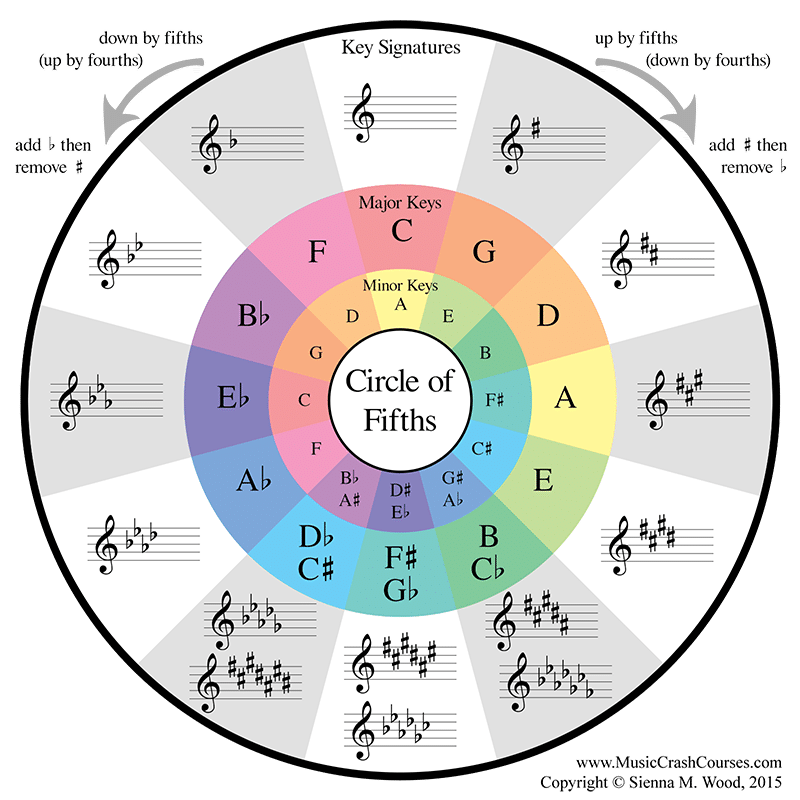
One of the most useful tools in music theory because it visually shows how keys, chords and scales are connected.
What is the Cycle of Fifths?
Imagine a clock face.
Starting at C at 12 o’clock, move clockwise in intervals of a perfect 5th:
C → G → D → A → E → B → F♯ → C♯
Each step adds one sharp to the key signature.
Moving anti-clockwise:
C → F → B♭ → E♭ → A♭ → D♭ → G♭
Each step adds one flat to the key signature.
A simplified version looks like:
How it benefits guitar learners

Learn chords in a logical order
Many songs use chords from neighbouring keys.
For example:
•Key of C: C, F, G, Am
•Key of G: G, C, D, Em
Notice how many chords are shared.
Learners can quickly see why so many songs use combinations such as:
•C – G – Am – F
•G – D – Em – C
•D – A – Bm – G
Rather than learning random chords, the Cycle of Fifths shows how chords naturally relate.
Improves understanding of key signatures
For learners studying theory grades or GCSE-level music, the cycle provides an easy way to remember key signatures.
Clockwise adds sharps:
Anti-clockwise adds flats:
Many students find this much easier than memorising every key individually.
Helps with transposing songs
Suppose a singer finds a song in C too high.
Using the cycle, you can quickly move it to G, F or D and understand how the chords will change.
This is a valuable skill for:
•Gigging musicians
•Accompanists
•Songwriters
•Guitar tutors
Makes improvisation easier
As students begin learning major scales and pentatonic scales, the cycle helps them understand:
•Which scales fit which chords
•Which keys are closely related
•Why chord changes sound smooth
For example:
A backing track in G major naturally relates to:
•G major
•E minor
•D major
•C major
These are all nearby on the cycle.
Develops ear training
When learners listen to music, they start recognising common chord movements.
The strongest resolution in Western music is often:
V → I
Examples:
•G → C
•D → G
•A → D
These movements are literally adjacent points on the Cycle of Fifths.
Once students hear this relationship, they begin identifying song keys and chord progressions more quickly.
Great for practice routines
A popular guitar exercise is:
Major chords around the cycle
Then:
Minor chords around the cycle
Benefits:
•Improves chord changing
•Builds fretboard knowledge
•Strengthens memory
•Encourages playing in less familiar keys
Essential for songwriting
Many classic songs use Circle of Fifths movement because it sounds naturally satisfying.
Examples include progressions like:
These create a strong sense of forward motion and resolution.
A simple way to teach it
I would usually introduce it in three stages:
1.Learn the major open chords
•C, G, D, A, E
2.Arrange them on the cycle
•Show that each chord is only one step away from its neighbours.
3.Play around the circle
•One strum per chord clockwise and anti-clockwise.
•Then add minor chords and scales later.
This makes theory practical immediately rather than something learners simply memorise.
The key takeaway
The Cycle of Fifths is really a map of musical relationships. For guitar learners it helps with:
✅ Chord progressions
✅ Key signatures
✅ Transposition
✅ Improvisation
✅ Ear training
✅ Songwriting
✅ Fretboard knowledge
Once you understand the Cycle of Fifths, many seemingly unrelated areas of music theory suddenly start fitting together.
Are you interested in taking some guitar lessons with L.A. Guitar School, if so and you would like some more information about lessons drop me a message <<here>>
if you would like more indepth in information on the cycle of fifths check ou this page